
|
|
||||||||||||||||||


| New revised electoral calendar (Oct. 28, 2026) |

|
 |
|
|
|
|
|
|
|||||
|
|
Development of the electricity sector in Haiti 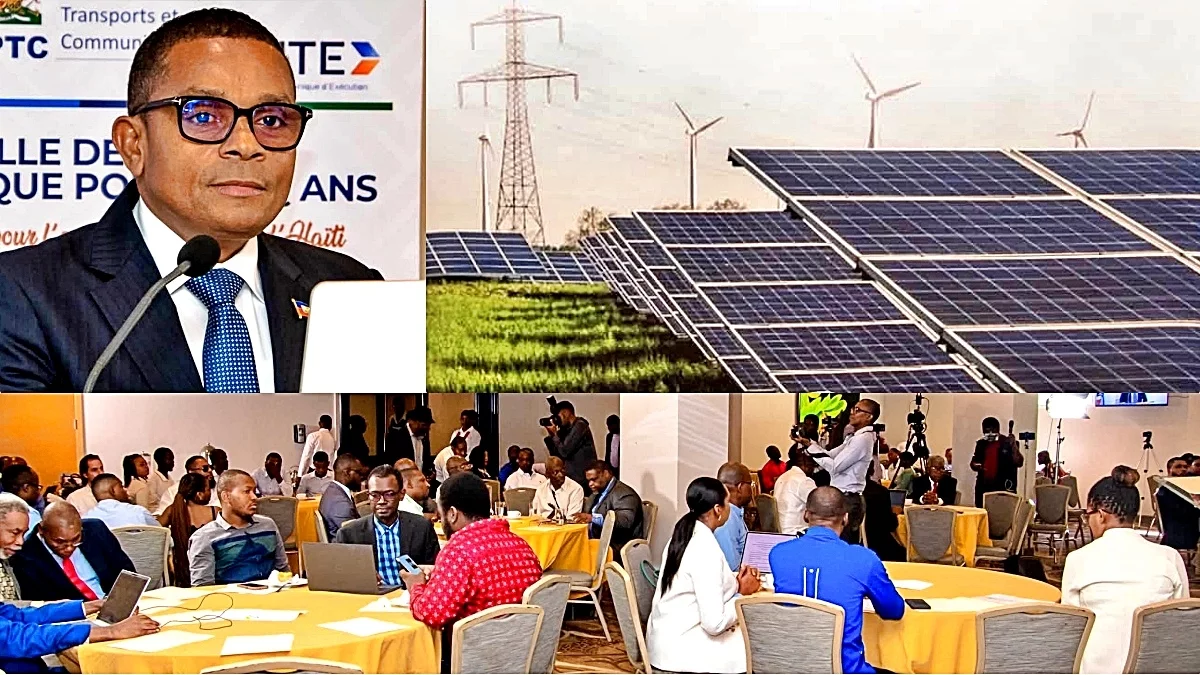
On Thursday, October 29, 2026, the Ministry of Public Works organized a national workshop dedicated to the planning and development of the electricity sector in Haiti. This initiative, organized in collaboration with the Technical Execution Unit of the Ministry of Economy and Finance and the National Energy Sector Regulatory Authority (ANARSE), aims to lay the foundation for an energy policy that is structured, sustainable, and tailored to the country’s needs. Under the leadership of engineer Joseph Almathe Pierre Louis, Minister of Public Works, the workshop brought together various stakeholders, including members of the government, such as Ministers Sandra Paulemon (Planning) and Valéry Fils-Aimé (Environment) as well as representatives from technical and financial partners and key players in the sector. In his address, Minister Pierre Louis stated, "Haiti will not recover through improvisation. It will recover through discipline, planning, and institutional rigor." For the Minister, electricity cannot be viewed merely as a matter of generating megawatts, building power plants, or expanding distribution networks. Rather, he argues, it is a matter of human dignity, territorial justice, economic competitiveness, and national sovereignty. This vision places energy at the heart of the country’s economic and social transformation. A reliable power supply is essential for fostering agricultural irrigation in the Artibonite region, supporting the processing and preservation of agricultural products in the South, developing cold-chain infrastructure for the fishing industry, and reducing production costs for businesses. "We do not simply want to light up homes. We want to brighten the prospects for our population." One of the core pillars of the electrification plan involves the development of six regional grids designed to progressively handle power generation, transmission, and distribution, as well as the connection of end-users—with the potential for interconnection once technical conditions allow. The framework also includes the deployment of mini-grids for remote localities and standalone solar systems for areas where dwellings are widely dispersed. In an initial phase, approximately 50 mini-grids could serve nearly 100,000 households. This would be supplemented by individual solar systems for an additional 227,000 households. The Minister emphasized the need to build an energy policy that encompasses all 10 departments, 149 communes, and 574 communal sections across the country. The roadmap for the 2027–2032 period sets several key objectives, including : increasing the electricity access rate to 60%; completing 250,000 new connections—150,000 of which would be through decentralized solutions—and reducing technical and commercial losses to below 35%. The document also outlines a reliable generation capacity of 200 megawatts for the metropolitan area and 80 megawatts for the rest of the country, alongside the training of 500 technicians and managers to strengthen national expertise within the energy sector. The investments currently quantified in the plan are estimated at between 5.7 and 5.9 billion US dollars. This figure serves as a baseline, which is expected to be expanded as additional long-term generation needs arise. The Minister noted that a 13.4-megawatt solar power plant, paired with a battery storage system, is currently under construction in Caracol, in the Northeast. It is intended to help strengthen the electricity supply for Caracol, Limonade, Sainte-Suzanne, Trou-du-Nord, and Terrier-Rouge. In Jacmel, at the Monfleury site, a 4-megawatt solar power plant with storage is also being built for integration into the local grid. Together, these two projects represent 17.4 megawatts of solar capacity currently under construction. Meanwhile, two pilot projects are being prepared in Les Cayes and Fort-Liberté. According to current studies, each could reach a solar generation capacity of 15 to 20 megawatts, complete with storage systems and the necessary infrastructure. The program also includes initiatives for hybrid mini-grids in several locations, specifically in Vallières, Mont-Organisé, Capotille, Tiburon, La Cahouane, Marfranc, Moron, Chambellan, Beaumont, and Dame-Marie. In conclusion, Minister Pierre Louis reaffirmed the need to move from planning to action, from action to results, and from results to a sustainable improvement in the population’s living conditions. "Electrifying Haiti means unlocking its potential. Generating energy means supporting national production. Building infrastructure means paving the way for prosperity." For the Ministry, the challenge now lies in translating strategic directives into concrete achievements—initiatives capable of expanding access to electricity and providing sustainable support for the country’s economic transformation. HL/ S/ HaitiLibre
|
|




|
|
Why HaitiLibre ? |
Contact us |
Français
Copyright © 2010 - 2026 Haitilibre.com |