
|
|
||||||||||||||||||


| 2026-2027 Electoral Calendar, latest official version |

|
 |
|
|
|
|
|
|
|||||||
|
|
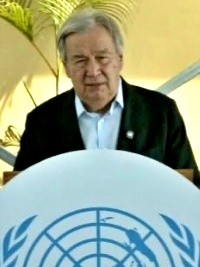
Speech by SG António Guterres before leaving Haiti
On Tuesday, June 16, 2029, Secretary-General António Guterres, after a brief visit to Haiti before departing that same evening, stated at a press conference, "In a few moments, I will leave your country, but what I have seen here will stay with me [...] Press Conference by António Guterres "[...] Ladies and Gentlemen of the press, Thank you for being here. I came to Haiti with a simple message: you are not alone. The United Nations stands with you. And the world cannot turn a blind eye. In a few moments, I will leave your country. But what I have seen here will stay with me. I have seen a crisis of extraordinary proportions, rooted in insecurity. Gangs are terrorizing the country. Entire families have been uprooted. Children are deprived of protection, education, and a future. For too many Haitians, every day is a struggle for survival. But I have also seen—and above all—a people standing strong. This morning, at a camp for displaced people, I met families who have lost everything and yet are holding on, together, with a courage and dignity that command admiration. Their resilience deeply moved me. And it compels us all. These families didn't ask me for compassion. They are waiting for action. The numbers speak for themselves. But behind each one, there is a life. Haiti is experiencing the worst humanitarian crisis in the Western Hemisphere – and the fastest deteriorating. 6.4 million people – more than one in two Haitians – are in need of assistance today, compared to 5.5 million two years ago. Nearly 1.5 million people are internally displaced by violence. And nearly 6 million people are facing severe food insecurity. Women and children are paying the heaviest price. In the first quarter of this year, on average, more than 20 women and girls were assaulted every single day. In just one year, the recruitment of children by gangs has tripled. Now, up to one in two gang members is a child. Childhoods stolen—through violence, exploitation, and hunger. This is the true nature of these groups, which thrive by exploiting the most vulnerable. This is absolutely intolerable. It must stop. I want to commend our humanitarian colleagues and partners—the vast majority of whom are themselves Haitian—who do not give up, despite the dangers. Last year, they provided life-saving assistance to nearly 3 million people. But our response plan—$880 million to help 4.2 million people—is only a quarter funded. I say this bluntly to the donors: Haiti is not asking for charity. Haiti is asking the world to keep its word. And Haiti cannot wait. Ladies and Gentlemen, This crisis is also, fundamentally, a security crisis. Since the beginning of the year, gang violence has left more than 2,300 dead and more than 1,100 wounded. It is paralyzing the state, the economy, education, and the delivery of aid. Yet, the greatest shame is not the gang violence. The greatest shame is the indifference—that of a world that has looked the other way for too long. Because there is a direct link between the absence of the international community and the lack of security for the Haitian people. But the situation can be reversed. Neighborhoods in downtown Port-au-Prince have been retaken. The Council of Ministers is meeting again at the National Palace after more than three years. This is not just a symbol: it is a sign of the gradual return of the State. Today, at Camp Vertières, I also met with the men and women of the Anti-Gang Force. Its deployment offers a real opportunity to reduce violence and restore the authority of the State. We cannot afford to squander this opportunity. This force is not a United Nations operation, but it benefits from our full logistical and operational support through our support office in Haiti. I thank the Governments of Haiti and the Dominican Republic for their crucial cooperation. I also want to commend the Haitian police officers and soldiers who hold the line, day after day, often at the risk of their lives. These forces must receive the training, equipment, and coordination necessary for their mission – in strict compliance with human rights. Because human rights and the fight against impunity are not an obstacle to security: They are a prerequisite and the foundation of public trust. And for these gains to last, gang members must be disarmed, dismantled, and reintegrated—under Haitian leadership. A functioning justice system is essential. And the flow of illicit weapons that fuels this violence must be stopped. Because these weapons are not manufactured in Haiti. But security alone will not suffice. It must go hand in hand with political progress. I had frank discussions with Prime Minister Alix Didier Fils-Aimé, as well as with representatives from various sectors of Haitian society. My message was clear: the Haitian people have waited far too long. The opportunity before us today may not come again – I am counting on Haitian leaders to seize it. The political process must be accelerated and trust restored. It is up to the Haitian people, and them alone, to chart the course. And this process must produce results: inclusive transitional phases and credible elections – the only legitimate path to restoring constitutional order and democratic institutions. The United Nations remains fully committed. Under the leadership of my Special Representative, Mr. Carlos Ruiz Massieu, and through BINUH, we will continue to facilitate dialogue and support Haitian solutions. The transition is moving forward. There is momentum. My appeal to the international community is therefore simple: finally assume your responsibilities. First: strengthen security support—with a rapid and full deployment of the Force—adapting resources to the progress made on the ground. Second: support the political transition and the country's recovery—education, health, employment—to offer young Haitians an alternative to gangs and a future of dignity. Third: fund humanitarian aid, predictably and in line with the needs. And above all: listen to the Haitian people. Ladies and Gentlemen, I leave Haiti with a message of hope. For the first time in years, we can see the light at the end of the tunnel. Because Haiti is not defined by its hardships. It is a vast and creative youth. An engaged diaspora. A culture that shines far beyond its borders. Haiti has everything it needs to rise again. More than two centuries ago, in Vertières, a people accomplished what the world thought impossible: they broke their chains and liberated themselves. This people, I am convinced, will free themselves from the grip of the gangs—and reclaim their security, their institutions, their future. Our role is not to act in your place. Our place is by your side. And we will be there—until the very end. Thank you." See also : HL/ HaitiLibre
|
|






|
|
Why HaitiLibre ? |
Contact us |
Français
Copyright © 2010 - 2026 Haitilibre.com |